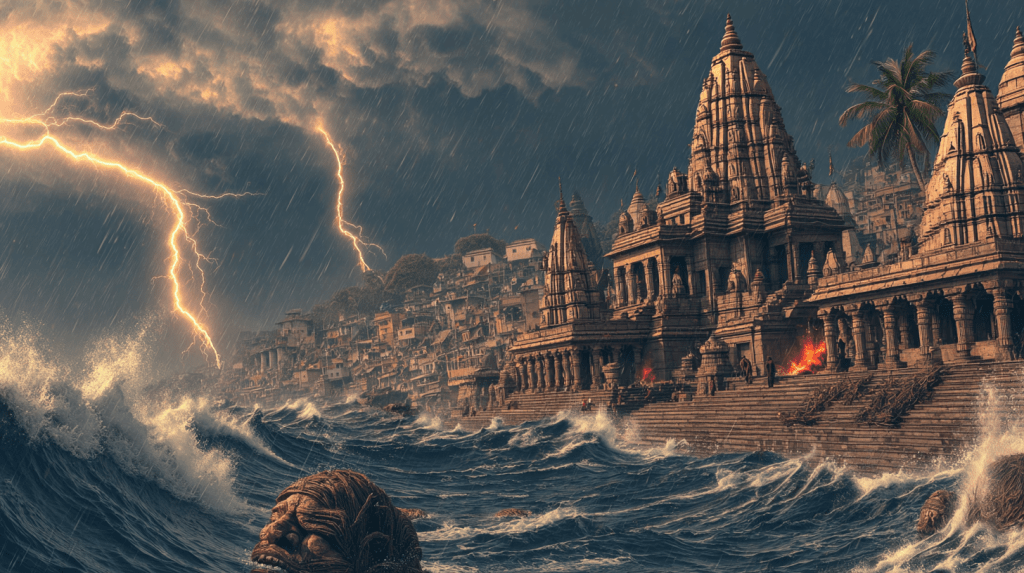
As dawn breaks over Madurai, the fourteen towering gopurams of the Meenakshi Temple emerge from the morning mist — their surfaces alive with 33,000 painted sculptures of gods, demons, and celestial beings. The air hums with temple bells and the fragrance of jasmine garlands carried by thousands of devotees who have come, as they do every single day, to stand before the goddess with the fish-shaped eyes.
The Meenakshi Amman Temple in Madurai, Tamil Nadu, is not merely a place of worship — it is a living city within a city, a 2,500-year-old cosmic statement in stone and colour. Dedicated to Goddess Meenakshi, an incarnation of Parvati, and her consort Sundareswarar (Shiva), this temple has anchored the spiritual and cultural life of an entire civilisation. According to the Archaeological Survey of India, it remains one of the most architecturally significant temple complexes on the subcontinent.
Quick Facts
- Location: Madurai, Tamil Nadu
- Deity: Goddess Meenakshi & Sundareswarar
- Architecture: Dravidian (Tamil style)
- Built by: Pandya Kings; Madurai Nayaks (16th–17th c.)
- Temple area: 14 acres (5.7 hectares)
- Gopurams: 14 towers (tallest: 170 ft / 52 m)
- Timings: 5:00 AM–12:30 PM & 4:00–10:00 PM
- Entry fee: Free (museum: ₹50)
- Best time: October – March
- Official site: hrce.tn.gov.in
HISTORY
A History Written in Stone: 2,500 Years
Ancient Origins and the Pandya Legacy
The story of the Meenakshi Temple begins long before the current structures were built. Sangam literature — Tamil’s oldest recorded poetry, dating to 300 BCE–300 CE — references Madurai as a sacred city. The Pandya kings claimed Goddess Meenakshi as their royal patron and poured centuries of wealth into her sanctuary, producing the innermost shrines and the sacred tank — the Potramarai Kulam (Golden Lotus Pond) — still glistening at the temple’s heart.
Destruction and Rebirth
In 1310 CE, the armies of the Delhi Sultanate under Malik Kafur swept through Madurai, looting and demolishing the temple. The Vijayanagara Empire, rising in the 14th century, undertook a massive restoration — and then the Madurai Nayaks transformed what had been rebuilt into something far grander.

ARCHITECTURE
Architecture: The Dravidian Cosmos in Stone
The Gopuram — Gateway to the Divine
The temple has 14 gopurams total. The tallest — the southern tower — rises 170 feet (52 metres). Each is a tapering pyramid encrusted with thousands of stucco figures, repainted every twelve years during the Kumbhabhishekam consecration ceremony. The Tamil Nadu Tourism Board describes this as one of the finest examples of Dravidian temple architecture anywhere in the world.
The Hall of a Thousand Pillars
The Aayiram Kaal Mandapam contains 985 pillars — never quite a thousand, an intentional philosophical humility. Musical pillars emit different notes when tapped, a feat of acoustic engineering that researchers at the Indian Institute of Technology Madras have studied but not fully explained.

The Sacred Tank
The Potramarai Kulam (Golden Lotus Tank) sits within the temple complex and is referenced in ancient Tamil Sangam poetry as a place where scholars tested their literary compositions — floating manuscripts on the water, keeping only those that stayed afloat. According to Encyclopædia Britannica, the tank is over 165 feet long and serves as a central ritual space for the temple’s elaborate festival calendar.
DEITY & LEGEND
The Goddess with Fish Eyes: Deity and Legend
Who is Meenakshi?
Meenakshi — fish-eyed one in Tamil — is an incarnation of Parvati. In Tamil iconography, fish-shaped eyes symbolise ideal beauty: wide, clear, full of grace. She is depicted as a young queen, green-complexioned (symbolising fertility), holding a parrot and a garland. The Sahapedia cultural encyclopaedia notes that Meenakshi is one of the few Hindu goddesses who is also revered as a ruling sovereign in her own right.
The Founding Legend
According to the 16th-century Tamil text Thiruvilaiyadal Puranam, King Malayadhwaja performed a fire sacrifice seeking an heir. From the flames emerged a three-year-old girl with three breasts. A divine voice declared: “When she meets her true husband, her third breast will vanish.” She grew into a warrior queen who conquered the three worlds — and when she finally met Shiva at Mount Kailash, her third breast disappeared, and the great wedding of Meenakshi and Sundareswarar took place.

FESTIVALS & RITUALS
Festivals: When the Temple Becomes a Universe
Meenakshi Tirukalyanam — The Celestial Wedding
Every year during the Tamil month of Chithirai (April–May), Madurai transforms into the cosmic wedding hall of Meenakshi and Sundareswarar. The Chithirai Thiruvizha festival draws over 1 million pilgrims across 15 days. The temple’s official records show this as the largest annual gathering in Tamil Nadu.
The 12-Festival Calendar
The temple observes a festival in every single month of the Tamil calendar — 12 months, 12 festivals — each with its own rituals, processions, and significance. The daily puja schedule runs six times a day, from the 5:00 AM awakening ceremony to the 10:00 PM night blessing.
VISITOR GUIDE
Visitor Guide: Planning Your Pilgrimage
Getting There
By air: Madurai Airport (IXM) has direct flights from Chennai, Bangalore, Mumbai, and Delhi — check MakeMyTrip for current fares. By train: Madurai Junction connects to all major South Indian cities. By bus: TNSTC operates frequent services from Chennai (9 hrs), Coimbatore (4 hrs), and Trichy (2.5 hrs) — details on tnstc.in.
Inside the Temple
Timings: 5:00 AM–12:30 PM and 4:00 PM–10:00 PM daily. Non-Hindus are welcome everywhere except the innermost sanctum. Dress code: no shorts or sleeveless tops — traditional garments available at the entrance for hire. Photography is permitted in most areas except the sanctum.

SIGNIFICANCE
Why Meenakshi Temple Still Matters
The state emblem of Tamil Nadu is based on the western gopuram of this temple — a civic statement that Meenakshi is not just a religious site but a cultural foundation of an entire state. In 2017, it was declared India’s cleanest iconic place under the Swachh Bharat Abhiyan by the Government of India. Nearly 15,000 devotees visit daily; on festival days, hundreds of thousands.

EXPLORE MORE
Related Temples Worth Visiting
- Brihadeeswarar Temple, Thanjavur — The greatest Chola achievement in stone and a UNESCO World Heritage Site
- Ramanathaswamy Temple, Rameshwaram — The longest temple corridor in India, at the edge of the sea
- Tirupati Venkateswara Temple — The world’s most visited pilgrimage site
Sources & Further Reading
- Archaeological Survey of India — Temple records and conservation reports.
- Meenakshi Temple Official Website — Hindu Religious & Charitable Endowments Dept., Tamil Nadu.
- Tamil Nadu Tourism Board — Madurai destination guide.
- Wikipedia — Meenakshi Temple (with full citation list.)
- Sahapedia — Cultural encyclopaedia entry on Meenakshi Temple.
- Encyclopædia Britannica — Madurai entry.
 10000 Temples of India